
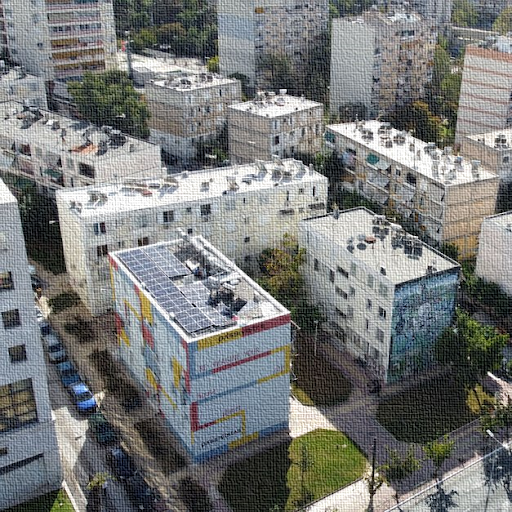
Renovation Progress Across Europe
The RINNO project deployed deep renovation works across four pilot sites in varying European climactic zones. These are:
- France (Lille – Wazemmes): An urban apartment building retrofitted with envelope insulation, a PV façade system, and glazing upgrades. Works at the pilot site were completed in March 2024.
- Greece (Athens – Tavros): A 1970s social housing building given façade insulation, thermochromic glazing, BIPV, and mechanical ventilation. Renovation works were completed in January 2025.
- Denmark (Slagelse): A social housing building renovated with ventilation solutions, insulation upgrades, PV systems, and hybrid retrofitting components. Works were completed in April and August 2025.
- Poland (Rajszew): Multi-family housing at which renovation was planned but not completed due to repeated over-budget tenders. Renovation works are planned after August 2025.

The four demosites in France, Greece, Poland, and Denmark
Across these four pilot sites, RINNO focused on three core objectives:
- The implementation of innovative renovation technologies,
- Testing the RINNO Suite, a set of IT tools supporting the full renovation process,
- Evaluating renovation impacts and performance indicators.
Innovative Technologies in Practice
Based on IT-guided renovation scenarios, the demo sites integrated a wide range of new technologies. In France, these included:
- Robotic exterior insulation
- InVentilate Double Flow Ventilation Box
- K-FLEX biobased insulation pipes and valves
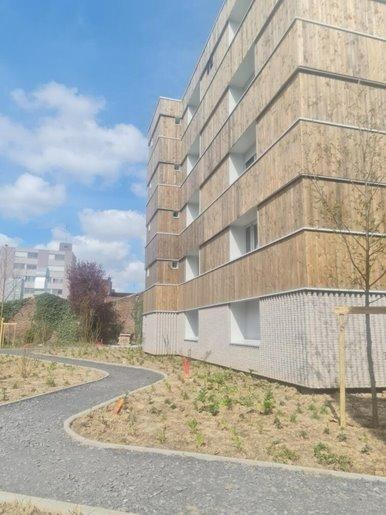
The insulated facade at the French pilot site
In Greece, the pilot site featured:
- Bio-based double-layer K-FLEX panels
- Thermochromic glass (GREENSTRUCT)
- Building-integrated PV panels (GREENSTRUCT)
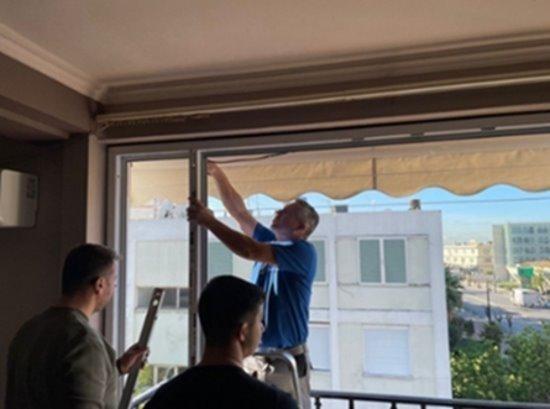
New thermochromic glass windows being installed at the Greek pilot site
The Danish pilot site presented:
- ZAPPA pre-fab PV façade
- PINK water heaters
- InVentilate micro-ventilation
- IsoCell paper wool
- K-FLEX valves
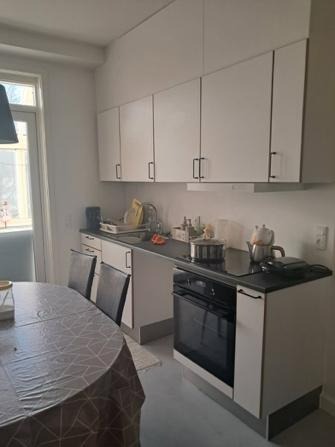
The new kitchen in the Danish demo
Lastly, planned renovation technologies in Poland include:
- Bio-based K-FLEX panels
- Isocell cellulose insulation
- Zappa pre-fab PV façade solutions

RINNO’s Innovative Technologies
In total, nine innovative technologies and robotic systems were tested. Five technologies were deployed at two sites (InVentilate, K-flex panels and valves, Zappa, and IsoCell), while four were installed at one site only. Some installations were limited by regulatory or climatic barriers, particularly in Poland and France.
The technologies progressed by 1–3 TRL (Technology Readiness Levels), with installations including modular building envelope solutions, RES harvesting and storage, and hybrid retrofitting systems. Performance monitoring showed significant energy savings (up to 100% in Greece) and high user acceptance (>90%). However, cost reductions and time savings could not be fully demonstrated within the project timeframe. The energy savings, however, showed significant improvements:
| Baseline (from Proposal) kWh/m2 | Reduction calculated (from Proposal) % | Reduction calculated (by INTEMA) % | Monitoring 2024-2025 kWh/m2 | Actual reduction 2025 (%) | |
| France | 321 kWh/m2/y | 104 kWh/m2/y =68% | 67% | 97,26 kWh/m2/y | 70% |
| Greece | 250 kWh/m2/y | 45 kWh/m2/y =82% | 85/100%* | 87,65 kWh/m2/y | 65% |
| Denmark | 159 kWh/m2/y | 108 kWh/m2/y =32% | 22% | 106,81 kWh/m2/y | 33% |
| Poland | 300 kWh/m2/y | 63kWh/m2/y =79% | 80% | TBD | TBD |
Improvements in the energy Consumption at the demo sites – calculated and monitored (* HPHI calculation)
Digital Tools Transforming Renovation
The RINNO Suite was completed with tools to support the whole renovation process, from planning and design to implementation and management. The IT tools are interconnected, so that uploading and collecting information from each technology in the Suite informs the next tool, saving time in comparison to the current industry standard.
The RINNO Suite provided key digital support at all demo sites. The following two in particular were implemented with success:
- Decision-making tools for selecting renovation scenarios,
- An augmented-reality tool assisting with installation of new technologies.
Positive Stakeholder Feedback
The project’s evaluation included surveys of 37 stakeholders – tenants, owners and professionals:
- 90.5% of tenants and owners were satisfied or very satisfied
- 92% of professionals expressed the same positive assessment
Replicability
RINNO also examined its potential for broader replication. Across the four demo cities, 9,620 buildings were identified as suitable for adopting RINNO solutions. RINNO, thereby, has a highly scalable model with strong potential impact when adopted across similar European urban areas.
This potential, as presented in the project’s Replicability Analysis, shows that RINNO has:
- 285 GWh/year potential primary energy savings
- 106,031 tCO₂eq/year potential emissions reductions
Conclusion
Crucially, innovative technologies have all been installed and tested to be satisfactory, and future renovation processes have now been developed and tested, and are ready for wider deployment.
*The header image shows the Greek demo site’s renovated block with PV on the roof
 This project has received funding from the European Union's Horizon 2020 research and innovation programme under grant agreement No 892071.